
IR information
Dividend policy / Share buybacks / Shareholder benefits
Updated: May 20, 2026
Dividend policy and dividend forecast
The Company believes that returning profits to shareholders is a vital issue facing company management, and is taking a series of measures corresponding to our belief. The Company’s basic dividend policy is to conduct the stable, continuous payment of dividends, taking a comprehensive evaluation of business performance and the business environment into account. The Company’s standard has been a dividend payout ratio of 50% or higher. In consideration of capital efficiency and to ensure an even stabler return, the Company has newly added the indicator of DOE (Dividend on Equity attributable to owners of parent). Our new standard for dividend payments is a minimum DOE of 4.0% and a dividend payout ratio of 50% or higher.
The Company forecasts annual dividends of 42 yen per share for the fiscal year under review, with a year-end dividend of 22 yen in addition to the second quarter-end dividend of 20 yen (regular dividend of 18 yen and a special dividend of 2 yen to commemorate the Company’s 95th year of business), which has already been paid. This is expected to result in a dividend payout ratio of 50.5% and DOE of 4.3%.
The Company forecasts annual dividends of 44 yen per share for the fiscal year ending March 31, 2027, with a second quarter-end dividend and a year-end dividend of 22 yen each.
Dividend per share (Yen)
| Interim dividend (Yen) | Year-end dividend (Yen) | Annual dividends (Yen) | Dividend payout ratio (%) | DOE (%) |
|
|---|---|---|---|---|---|
| Fiscal year ended March 31, 2026 (FY2025 results) | 20.0 | 22.0 | 42.0 | 50.5 | 4.3 |
Share buybacks
The Company believes share buyback for treasury is an important policy for returning profits to shareholders and improving capital efficiency. In the fiscal year under review, the Company purchased 854,000 shares of treasury shares. The total payout ratio, combining dividend payments and share buyback during the fiscal year under review, was 97.4%, remaining at a high level.
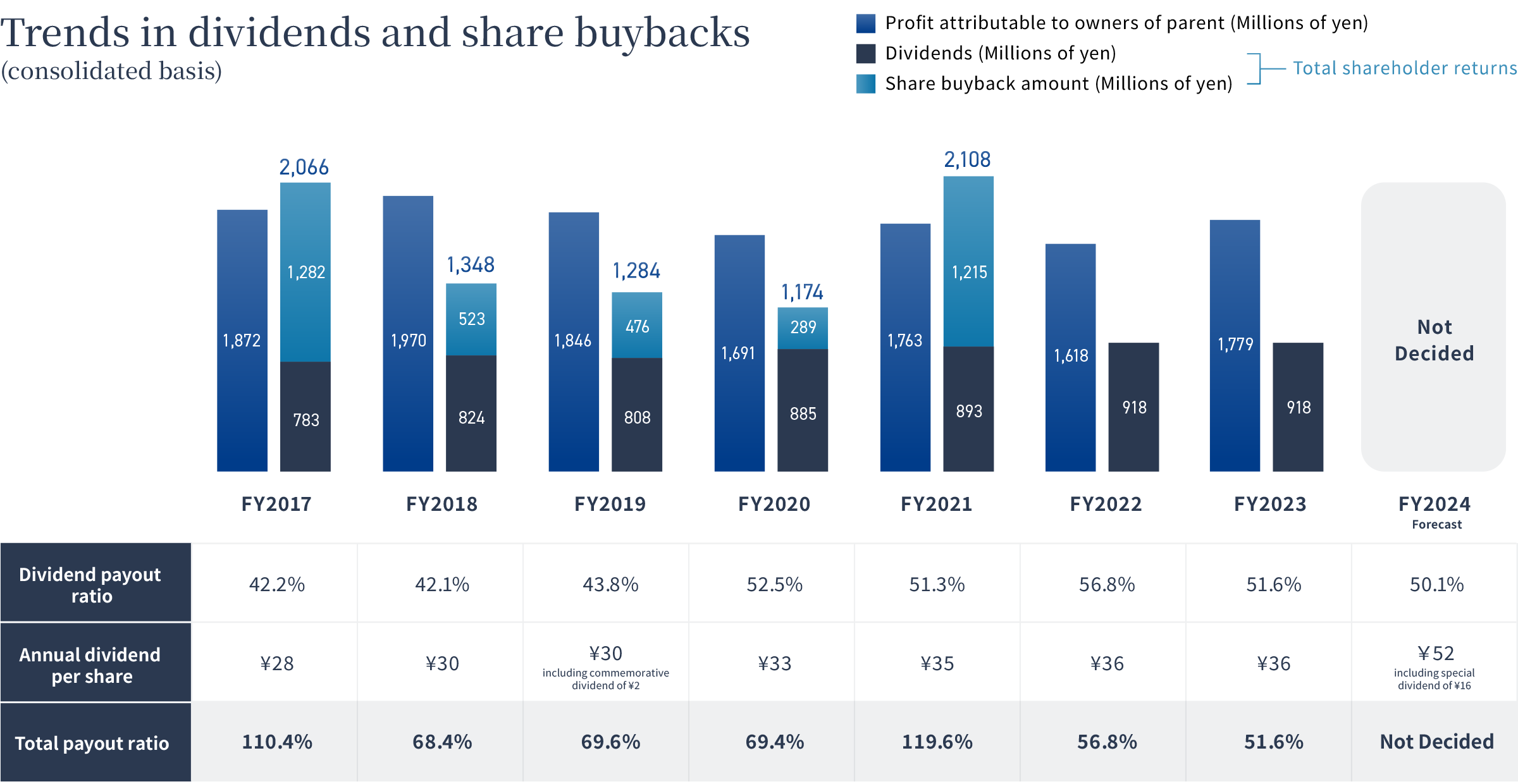
- The annual dividend for the fiscal year ending March 27 (forecast) is expected to total 44 yen, consisting of a second-quarter-end dividend of 22 yen and a year-end dividend of 22 yen.
Shareholder benefits
PRONEXUS has introduced a shareholder benefit program to express its appreciation to shareholders for their continuous support as well as to make investing in its stock more attractive so that shareholders retain shares for a long period of time.
<Description of shareholder benefits>
We provide shareholders with QUO prepaid cards based on their number of years of share ownership and the number of shares owned.
(Offered to shareholders with holdings amounting to 100 or more shares and listed in the shareholder registry as of March 31 each year)
| Number of shares owned | Number of years of ownership* | ||||
|---|---|---|---|---|---|
| Less than 1 year | 1 year or more | 3 years or more | 5 years or more | 10 years or more | |
| 100 shares or more | ¥500 card | ¥1,000 card | ¥1,500 card | ¥2,000 card | ¥3,000 card |
| 1,000 shares or more | ¥1,000 card | ¥3,000 card | ¥5,000 card | ¥7,000 card | ¥10,000 card |
- “Number of years of ownership” refers to the number of years that the same shareholder number has been listed in the shareholder registry.
FAQ
-
The record date for the year-end dividend is March 31, and the record date for the interim dividend is September 30.
-
The Company sends out shareholder benefits in late June together with the resolution notice, etc. after the conclusion of the ordinary general meeting of shareholders.
-
The date on which you receive your shareholder benefits may vary depending on your place of residence. However, if you have not received your shareholder benefits by the date of scheduled delivery, please contact the Corporate Agency Division of Mitsubishi UFJ Trust and Banking Corporation (toll free from within Japan: 0120-232-711).
-
We are unable to send the shareholder benefits to an address other than the one listed in the shareholder registry.
Please update your address with your securities company or use the Japan Post relocation/forwarding service.
-
Let’s turn to the following hypothetical situation in answering this question.
Consider a scenario where you became a shareholder upon having purchased 100 shares of stock 15 years ago. You subsequently purchase additional shares over a period of several years, resulting in holdings of 1,000 or more shares as of the record date.
Under this scenario, you would be eligible for a QUO prepaid card valued at ¥10,000, given that you have owned 1,000 shares or more for 10 years or more. Here, your number of years of ownership would refer to the number of years that you have held the shares continuously under the same shareholder number listed in the shareholder registry. As such, any changes in the number of shares held during the period would not affect your eligibility for the shareholder benefits.
However, under a scenario where your shareholder number changes as a result of you having made use of a securities lending service, your number of years of ownership would be reset to less than one year. In that case, we ask that you contact your securities company for details, given that handling of such matters varies depending on the securities company. Moreover, the number of shares owned is determined based on your holdings as of the applicable record date for benefit eligibility. As such, past share ownership is not taken into account.